

Last updated: May 2026
In this article we show you the truth behind momentum investing by busting 10 common myths. This article explains how momentum works, why it’s not just for short-sellers, and how it can be a powerful tool for individual investors like you. You'll learn how momentum has consistently outperformed other strategies, even with higher volatility. Whether you're new to momentum or skeptical, this post will give you the insights needed to consider adding it to your investment strategy, potentially improving your returns.
If you think stock price momentum (also called Price Index) is something only traders use and is of no use to long-term investors (including value investors) then this article is a MUST READ.
In May 2014 Cliff Asness, Andrea Frazzini, Ronen Israel, (all from AQR Capital Management) and Tobias Moskowitz from the University of Chicago published a very interesting paper called Fact, Fiction and Momentum Investing.
Momentum is over 25 years old
The paper clarifies, using already published research studies, the myths that have developed around the concept of momentum since it was first written about in 1993, more than 25 years ago.
What is Momentum?
You may be thinking what exactly is stock price momentum?
It is the observation that stock prices which have done well (increased more) relative to other companies on average continue to outperform. And that prices that have performed poorly (decreased more) tend to continue to under-perform.
The word relative is crucial as momentum is calculated by ranking a company’s share price movement against other companies.
For example if you look at 12 months momentum the stock with the best momentum is the one with the largest share price increase over 12 months.
Stock price momentum — definition:
The tendency of stocks that have outperformed their peers over the past 6–12 months to continue outperforming, and for underperformers to continue underperforming. Momentum is calculated by ranking a company's current share price change relative to its price in the past. Six-month momentum = current price ÷ price 6 months ago. First documented in academic research by Jegadeesh and Titman (1993). Also called Price Index (PI) in the Quant Investing screener.
How is it calculated?
In the Quant Investing stock screener we calculate 12 months momentum (we call it Price Index or PI) as (current share price / share price 12 months ago). This allows you to easily and quickly sort companies by share price momentum.
The screener has stock price momentum (or price index) available on all companies from 1 month up to 60 months for you to use when looking for investment ideas.
Momentum is not trend following
Momentum is often confused with trend following. But trend following is something completely different as shown in the following table.
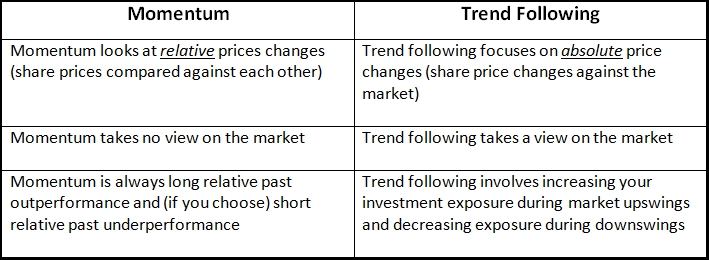
Source: Fact, Fiction and Momentum Investing
Momentum: History, Data and Methodology
Momentum has been a viable investment strategy for:
- US equities for more than 212 years (data since 1802).
- It has also been shown to work in 40 countries
- More than a dozen other asset classes like bonds, currencies, commodities and others.
Key Findings:
From Asness, Frazzini, Israel and Moskowitz (AQR Capital Management / University of Chicago, 2014) — "Fact, Fiction and Momentum Investing":
- Momentum (UMD factor) outperformed value (HML) and size (SMB) strategies across all three time periods tested — including a 36-year window (1927–1963), a 50-year window (1963–2013), and a 22-year window (1991–2013)
- On a risk-adjusted basis (Sharpe ratio), momentum was the best-performing factor in every period — despite having higher raw volatility
- Momentum generated positive returns 81% of the time on a rolling 1-year basis over the 1927–1963 period, versus 63% for value
- A combined 60% value / 40% momentum portfolio produced the highest percentage of positive returns across both 1-year and 5-year rolling periods — with the highest Sharpe ratio
- The effect holds across more than 212 years of US equity data, 40 countries, and more than a dozen asset classes including bonds, currencies and commodities
Screen for high-momentum stocks across 22,000+ companies worldwide
The research above covers decades of evidence — but applying momentum to your own portfolio requires current data. The Quant Investing screener gives you 1-month to 60-month price momentum (Price Index) for 22,000+ companies across 40+ countries. Sort any screen by momentum, combine it with value factors like the Magic Formula or Value Composite Two, and back-test the results.
Try the momentum screener free for 30 days
No credit card needed. Cancels automatically after 30 days.
Myths about Momentum Investing
Myth no. 1: Momentum returns are small and sporadic
To see if this myth is true, the authors compared it to the following investment strategies:
- RMRF: Equity Risk Premium or the aggregate equity returns minus the risk free rate. This is the out-performance of the stock market compared to cash.
- SMB: (Small minus Big portfolio) buy small stocks and sell large stocks, - capture the size effect.
- HML: (High minus Low portfolio) buy high book-to-price (same as low price to book) stocks and sell low book-to-price stocks.
- UMD: (Up Minus Down portfolio) buy stocks that have high relative one year price performance and sell stocks that have low relative one year performance, captures momentum.
The table below shows the return of size, value and momentum strategies. It also shows the Sharpe ratios, a ratio that calculates the performance of an investment by adjusting for its risk.
When comparing the return of different investment strategies the one with a higher Sharpe ratio gives you a better risk adjusted return.

Source: Fact, Fiction and Momentum Investing
Across all three time periods, momentum (UMD) outperformed value (HML) and size (SMB) strategies. Momentum does have higher volatility, but if you look at the risk adjusted returns (Sharpe Ratios), momentum was still the best strategy.
Momentum is not sporadic
The table below shows you if returns from momentum investing (UMD) are sporadic or not.
It shows the percentage of times each strategy generated positive returns (i.e., the longs beat the shorts).
For value this is how often the cheap stocks beat the expensive stocks, for momentum it’s how often winners beat losers)

Source: Fact, Fiction and Momentum Investing
What Momentum period is the best to use?
Over the 36 year period (1927-1963), of you look at 1 year rolling period, momentum is the most consistent, with positive returns 81% of the time as opposed to value, with positive returns 63% of the times.
If you look at 5 year rolling periods over the 36 year period (1927-1963), value (HML) does slightly better than momentum (UMD). In the other time periods, 1963-2013 and 1991-2013, momentum is as good if not better than value and size strategies.
As you can see returns using a momentum investment strategy are not sporadic.
Value and momentum an even better combination
If value and momentum each on their own can give you market beating returns what happens if you combine Value (HML) and Vomentum (UMD).
The paper also tested a combined value and momentum strategy with the following results:

Source: Fact, Fiction and Momentum Investing
You can clearly see that the combined portfolio (60% value 40% momentum) produces the highest percentage of positive returns, in both 1 year and 5 year periods with the best risk adjusted return (highest Sharpe ratio).
Myth no.2: Momentum cannot be used by long-only investors - it is a strategy for short selling
This myth that momentum can only be help you if you are a short seller just refuses to die, especially among value investors.
The paper looked at this and came up with the table below which shows the returns from investing long and short using in a momentum strategy.

Source: Fact, Fiction and Momentum Investing
As you can see long momentum has returned slightly more than short momentum strategies over long periods of time.
Thus the assertion of momentum only being “short strategy” is simply not true.
Myth no.3: Momentum returns are much larger for small caps than large caps
The table below compares the returns of momentum (UMD) and value (HML) strategies applied to small and large companies.

Source: Fact, Fiction and Momentum Investing
As you can see momentum returns from large companies are substantial even if they are slightly less than for small companies.
The larger returns for small companies can be due to of higher risk, inefficiencies (information availability) or simply because of larger price movements (volatility).
This is no different than the difference in returns from a value strategy (right part of table). Small companies value also returned more than large companies.
Myth no. 4: Momentum does not survive or is seriously limited by trading costs
There is no ignoring the fact that momentum is a high turnover strategy (our testing has found six months re-balancing best) compared to other strategies like value investing where you may hold an investments for years.
However the authors used data from AQR Capital, a large institutional investor, to show that for a large institutional investor, the average trading costs for momentum strategies are quite low.
This unfortunately does not help you as a small investor. One way you can overcome the problem is to invest in a fund that use momentum strategies.
Myth no. 5: Momentum does not work for taxable investor
In the paper the authors found that momentum, despite having 5-6 times the turnover of value investing for example, had a similar tax burden if you are a USA tax payer.
This is because:
- Momentum holds onto winners and sells losers quickly. This means that the profits from a momentum investment strategy will be taxed at the lower long term capital gains tax rate (in the USA if you have hold an investment for longer than a year) compared to the higher short term tax rate.
- Momentum stocks generally have lower dividend yield and as you know dividends are tax inefficient because of income and withholding taxes.
Myth no. 6: Momentum is best used with screens rather than as a direct factor
This myth says that momentum is not useful as the only factor you should use to find investment ideas but that it should be used in combining it with other investment strategies, value investing for example.
But if you look at the above mentioned results of a pure momentum strategy you will agree that momentum, used as the only factor, gave the best returns.
And if you do not use momentum (only value investing for example) I suggest you take a look at the paper Quantitative Value Investing in Europe: What Works for Achieving Alpha where you will find a wealth of data to prove that you are missing out on substantial gains if you ignore momentum in your investment decisions.
Myth no. 7: You should be worried about momentum’s returns disappearing
Like the previous myth, this myth accepts momentum as an investment strategy but says that the strategy would not work over long periods of time.
To bust this myth you only need to look at the long term track record of momentum (going back 212 years), as well as the evidence that it also works across different equity markets world-wide and asset classes to realize that momentum has worked for a very long time.
Momentum is new to the academic world
A reason this myth got started is that momentum is a “newer” investment strategy tested in academic studies.
It is however possible for momentum strategies to have low returns from time to time, this is true of all investment strategies.
High returns lead to low returns
As you know when an investment strategy has achieved high returns it attracts a lot of new investors which results in the companies the strategy selects becoming fully valued.
This then leads to lower or negative returns which in turn cause investors to abandon the strategy causing prices to fall which leads to the strategy starting to work again.
Myth no. 8: Momentum is too volatile to rely on
The authors agree that momentum is indeed more volatile than some other strategies. But as you saw momentum generated higher risk adjusted returns (higher Sharpe ratio) than value or size strategies.
To compensate for the high volatility the authors suggest combining momentum with value investing so that your portfolio will do better should the market decline substantially. This will help you to better withstand downturns in either value investment and momentum strategies.
For example it would have helped you when in 1999 (Internet bubble) when value performed terribly and momentum did well and in 2009 (financial crisis) when momentum performed terribly but value did well.
Myth no. 9: Different measures of momentum can give different results over a given period!
This is true, but this is also true for any other investment strategy. Different value strategies, for example price to book compared to price to earnings or earnings yield all would have given you different returns over the same time period.
There are also different ways to measure momentum. The most widely used momentum measurement uses the past 12 month data to find the relative winners and loser, but removes the most recent month (12-1 month momentum) to avoid liquidity and market structure issues.
Other measures of momentum uses time periods ranging from 3 to 12 months.
In a 2013 research paper titled The Other Side of Value: The Gross Profitability Premium Robert Novy-Marx suggests that momentum in the US markets is best measures using the past 7 to 12 months, and Goyal and Wahal in a 2012 paper titled Is Momentum an Echo? also found that in 35 (non US) markets past 12 months the best period to measure momentum over.
Myth no. 10: There is no theory behind momentum
Most theories that try to explain momentum fall into two categories; risk based and behaviour based.
Risk based explanations argue that momentum gives higher returns because of higher risk. Companies with higher momentum face greater future cash flow risk because of their growth prospects or have a higher discount rate due of their investment opportunities causing them to have a higher cost of capital.
Behaviour based explanations argue that momentum is either an under reaction or a delayed reaction (OR an overreaction or a hasty reaction) to news or events.
I am sure you also don’t care if there is a correct explanation as long as momentum works and you can use it to generate higher returns.
Summary
The paper has convincingly shown that momentum has worked for a long time, across different markets and asset classes which mean it is a great factor to use in your investment strategy.
Even though I was a classic value investor (a stock price could not fall enough) after spending months doing research for the paper Quantitative Value Investing in Europe: What Works for Achieving Alpha I became convinced about the value of adding momentum to your investment strategy.
Best investment strategies
You can find information on the best strategies we have tested and all of them use momentum here: Quant Investing best strategies we have tested
Frequently Asked Questions
1. What is momentum investing?
Momentum investing is selecting stocks that have outperformed their peers over a recent period — typically 6 or 12 months — on the basis that winners tend to keep winning and losers tend to keep losing. Asness et al. (2014) trace the documented academic evidence back to 1993, but show the effect has been present in US equity data going back to 1802.
2. Is momentum investing just for short-term traders?
No. The AQR paper shows that long-only momentum has historically returned slightly more than short-side momentum over long periods. Momentum generated positive returns 81% of the time on a rolling 1-year basis (1927–1963 data), which is more consistent than either the value or size factors over the same window.
3. Is momentum investing too risky?
Momentum does have higher raw volatility than value or size strategies. But on a risk-adjusted basis — measured by the Sharpe ratio — momentum outperformed both across all three time periods tested by Asness et al. Combining momentum with value investing (tested as a 60/40 split) produced the highest Sharpe ratio of any combination tested.
4. Can momentum be used for large-cap stocks?
Yes. The AQR research shows momentum generates substantial returns for large-cap stocks, not just small caps. Returns are slightly higher for small companies, but the same dynamic applies to value investing — small-cap value also outperforms large-cap value. Momentum is not a small-cap-only effect.
5. Isn't momentum investing too costly due to high turnover?
Momentum has 5–6 times the turnover of a value strategy. However, Asness et al. used AQR institutional trading data to show that actual transaction costs are low enough that the strategy remains profitable after costs for institutional investors. For individual investors, six-month rebalancing (rather than monthly) reduces turnover substantially.
6. Does momentum investing work during market downturns?
Momentum can underperform sharply during market crashes — as it did in 2009. This is exactly why the authors recommend combining momentum with value. In 1999 (the internet bubble), value performed terribly while momentum did well. In 2009, the reverse was true. A combined portfolio reduces the severity of drawdowns in either strategy.
7. Is momentum investing a short-selling strategy?
No. Long-only momentum has historically outperformed short-only momentum over long periods. The myth that momentum only benefits short sellers is, as the AQR paper documents, simply not supported by the data.
8. Has momentum been around long enough to trust?
Momentum has delivered positive returns across more than 212 years of US equity data (back to 1802), across 40 countries, and across more than a dozen asset classes. The academic literature on momentum as a factor dates to Jegadeesh and Titman (1993). The AQR paper (2014) reviewed and consolidated this research across more than two decades of subsequent studies.
9. Can momentum returns disappear over time?
All strategies go through periods of underperformance. Momentum is no exception. But the 212-year US track record, the cross-country evidence across 40 markets, and the cross-asset-class evidence all suggest momentum is a persistent structural feature of markets — not a temporary anomaly about to be arbitraged away.
10. Is momentum investing too complex for individual investors?
The calculation is straightforward: share price today divided by share price 6 or 12 months ago. Any stock screener with a momentum or Price Index column lets you sort and rank companies instantly. The Quant Investing screener provides 1-month to 60-month momentum for 22,000+ companies.
Put the momentum evidence to work in your own portfolio
Asness, Frazzini, Israel and Moskowitz reviewed more than two decades of research to reach one conclusion: momentum is real, persistent, and works best when combined with value. The Quant Investing screener gives you 1-month to 60-month Price Index data for 22,000+ companies across 40+ countries — so you can implement exactly the kind of combined value-and-momentum strategy the research supports.
Start building a momentum-based screen today
No credit card needed. Cancels automatically after 30 days.
Written by Tim du Toit — 39+ years of quantitative investing experience, author of Quantitative Value Investing in Europe: What Works for Achieving Alpha, and founder of the Quant Investing stock screener used by investors in 30+ countries.